
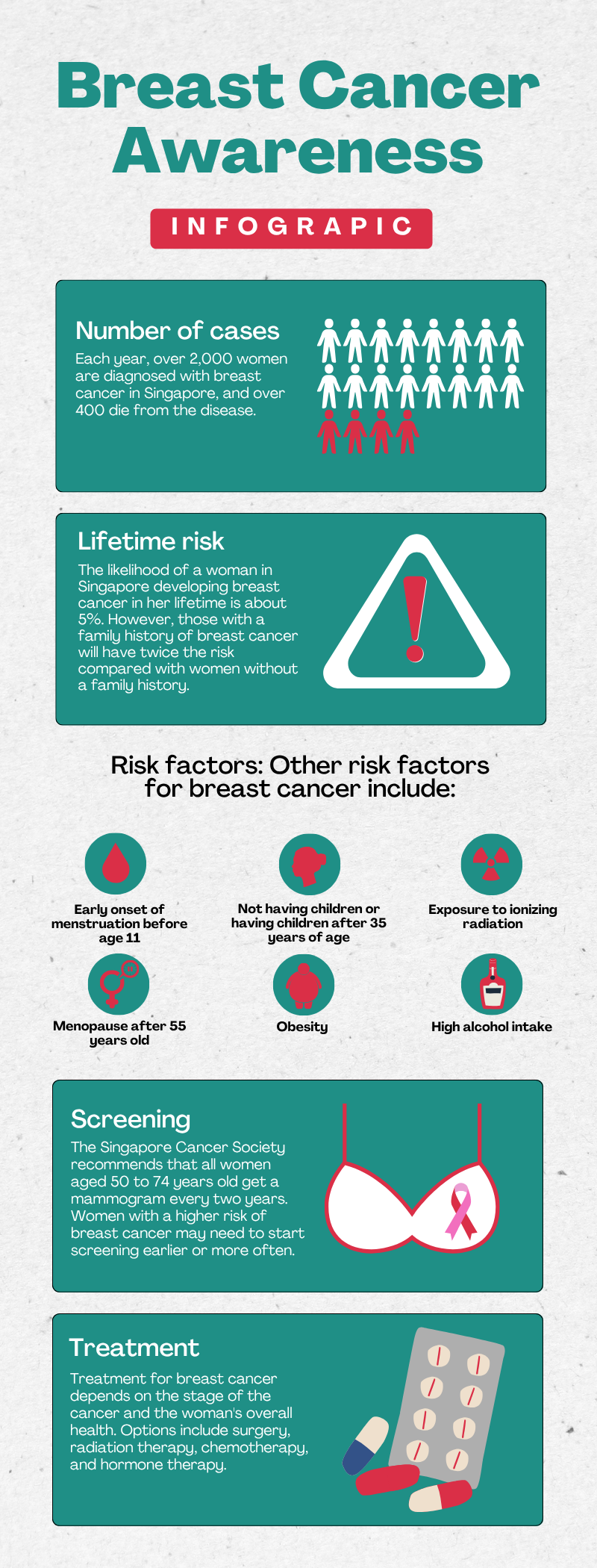
Cancer cases in Singapore have been rising over the years. Breast cancer, in particular, afflicts Singaporean women the most. Around 29.3% of the female population in the country have been diagnosed with the disease, which translates to 11,232 cases.
Still, medical technology has seen significant advancements, allowing women to live full lives despite having breast cancer. The key is to detect the signs early, so the treatment has the highest chance of being successful.
One way to nip the problem in the bud is by doing self-examination regularly. This article discusses why women should regularly check for signs of breast cancer and how they can do it properly.
Breast Cancer Awareness: Infographic
The Importance of Self-Examination
With regular self-examinations, women become more familiar with their breasts. They get to know how this part of their bodies normally looks and feels. This level of awareness allows them to see any signs of abnormalities or changes, no matter how subtle. It puts them in a better position to spot breast cancer in its early stages.
While self-examination is effective in detecting breast cancer early, it is not 100% reliable. That is why women should still go to the clinic periodically for check-ups, aside from doing regular breast self-examinations.
How to Perform Self-Examination
It is important to consult with health professionals on how to do self-examinations properly, especially if it is your first time. Once a doctor has shown you how to do it, you can perform it on your own.
To do a self-examination, you must have access to a mirror where you can see your whole upper body. Remove your clothing and stand in front of the mirror with your arms at your sides. Take note of how your breasts look.
Once you have done a visual examination, you can start checking for common symptoms using your hands. Use the fleshy pad of your three middle fingers as they are often less calloused and more sensitive.
These are the symptoms that you must look for:
- Changes in size and shape
- Swelling or presence of lumps
- Bloody discharge coming out of the nipples
- Redness or thickening of the skin on the area
- Redness and pain on the nipples
- Pain in a specific area that does not change from month to month
- Swelling of the lymph nodes in the armpits
If you detect any of these signs, make sure that you do not panic. These are common symptoms of breast cancer, but they could also be caused by other reasons. In addition, not all lumps are cancerous. Schedule an appointment with your doctor for a further check-up.
How Often Should You Do It?
According to health professionals, women should start doing breast self-examinations at the age of 20. It should be done at least once a month to create a familiarity with how the breasts normally look and feel.
If you are menstruating, it is best to wait for a few days after the period has ended before doing a self-examination. This will help ensure that there is no tenderness or swelling because of the monthly cycle.
Women experiencing menopause can do self-examinations any day of the month. However, it is best to pick a specific day to avoid forgetting. Those taking special medications like hormones should ask a doctor about when to do breast self-examinations.
What Other Tests Can You Take to Prevent the Development of Breast Cancer?
Mammogram screening and ultrasound tests can help identify lumps that are hard to detect with self-examinations. A biopsy can also be done to confirm if a lump is cancerous or not.
Conclusion
Breast cancer is a serious health issue that should not be taken lightly. Still, there are ways to detect it early so even women diagnosed with the disease can still live long and productive lives. The key is to be proactive by doing self-examinations regularly or visit a Singapore women’s clinic for cancer screening.
 Her Health Hub